
Publications
Discover the publications from the ECOSYSTEX community and its members.
Videos are available on ECOSYSTEX’s YouTube channel.
Filter by projects
- AEQUALIS4TCLF 2
- All 70
- CALIMERO 3
- CEMTex 1
- CISUTAC 6
- Colour4CRAFTS 1
- ECOSYSTEX 3
- EFFECTIVE 4
- HEREWEAR 3
- Hemp4circularity 1
- IMASUS 1
- IRISS 4
- LIFE TREATS 1
- My-Fi 2
- New Cotton 5
- PESCO-UP 1
- PROPLANET 8
- RegioGreenTex 17
- SCIRT 8
- SOLSTICE 5
- SUSTRACK 9
- T-Rex 7
- TRUSTEX 1
- VERDEinMED 1
- VETRINE 2
- Waste2BioComp 1
- tExtended 1

SOLSTICE's Territory Profile: Catalonia
The SOLSTICE project, funded by the EU’s Horizon Europe programme, aims to tackle the textile industry’s challenges by piloting circular solutions in Catalonia.

SOLSTICE's Territory Profile: Grenoble
The SOLSTICE project, funded by the EU’s Horizon Europe programme, aims to tackle the textile industry’s challenges by piloting circular solutions in Grenoble.

SOLSTICE's Territory Profile: Prato
The SOLSTICE project, funded by the EU’s Horizon Europe programme, aims to tackle the textile industry’s challenges by piloting circular solutions in Prato.

SOLSTICE's territory profile: Berlin
The SOLSTICE project, funded by the EU’s Horizon Europe programme, aims to tackle the textile industry’s challenges by piloting circular solutions in Berlin.
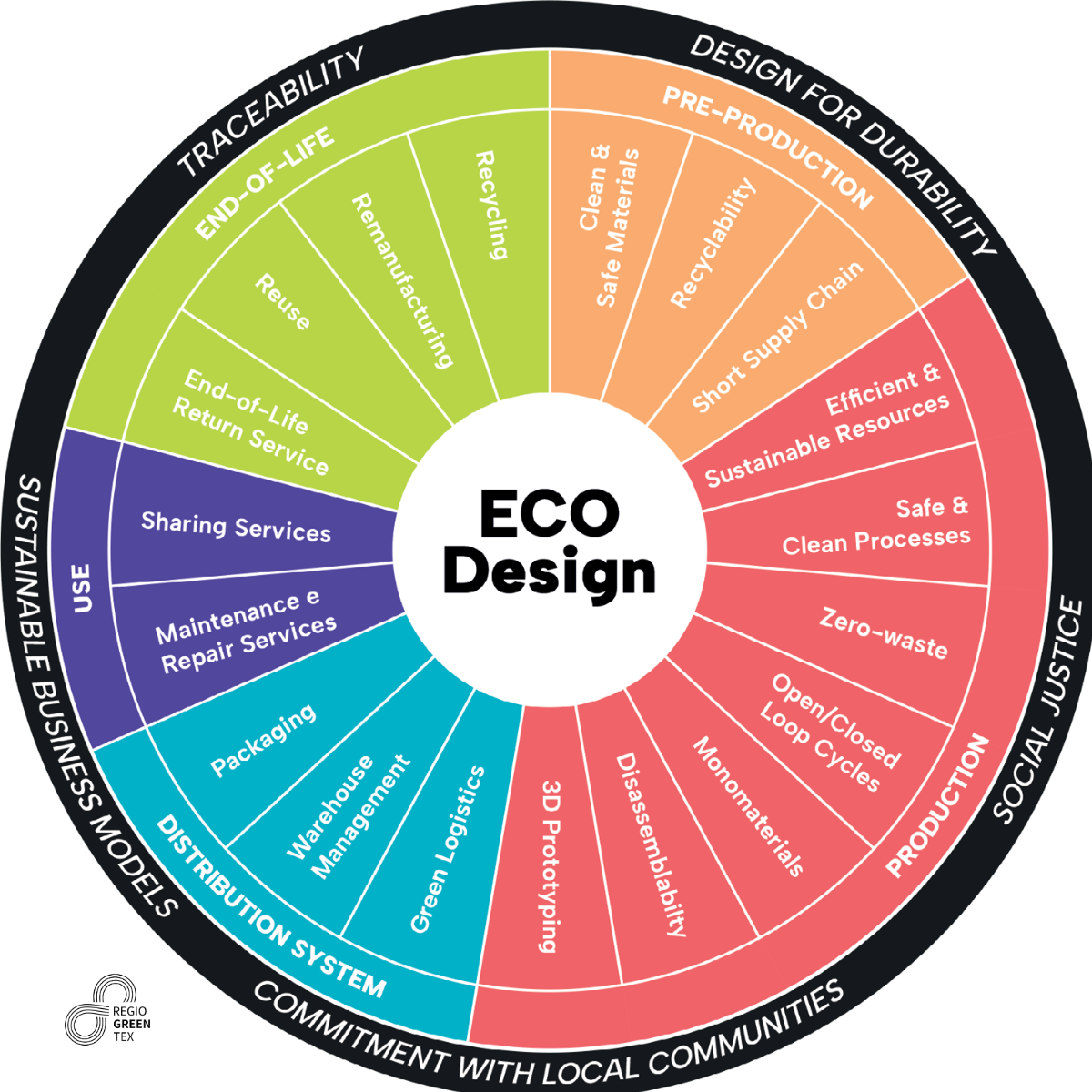
RegioGreenTex: Eco-Design Strategies
RegioGreenTex developed this report to promote open dialogue in building a sustainable textile supply chain. Ecodesign thrives through collaboration between designers, producers, distributors, and those involved in recovery, repair, and reuse. This guide is the result of a joint effort between Next Technology Tecnotessile and the Service Design Lab at the University of Florence.
RegioGreenTex: From Rags to Regulations
The goal of this document is to help textile companies navigate waste legislation on the EU-level and, where applicable, also on the Flemish level. It provides practical steps on how to comply with various pieces of legislation and explains concepts such as end-of-waste, environmental permits, registrations and waste transports.

SOLSTICE's report on analysis of consumer research
This report aims to summarise findings about consumer behaviour related to circular textiles in the four territories: Catalonia, Berlin, Prato, and Grenoble as researched under the SOLSTICE project.

T-REX Project White Paper on Advancing Textile Circularity: Policy Recommendations for Implementing ESPR in the EU
T-REX Project released a white paper providing strategic recommendations for policymakers to facilitate a robust and sustainable textile recycling ecosystem in the EU.
AEQUALIS4TCLF project: D3.3: TCLF Skills Needs Analysis Report
An analytical report identifying key green and digital skills required in the TCLF industry, supporting workforce transformation.

Waste2BioComp’s report on benchmarking and technology watch
This report represents the final version of the Report on benchmarking and technology watch. It describes W2BC strategic benchmark and technology watch. Benchmarking strategic tool assists in the achievement of excellence, enabling improvement by borrowing and adapting the successful ideas and practices of organizations while avoiding unproven or problematic strategies.

Overview of renewable resources and their availability (Textile Market)
ECOSYSTEX Technical Working Group 4 (Renewable Materials & Standards) created an overview of the different types of renewable materials, with a focus on bio-based, regenerated and recycled, and of different types of material and their availability on the market as such, and in fibre form.

Overview of standardisation Committees, published and under development standards, and gap analysis for renewable materials/ textiles
ECOSYSTEX Technical Working Group 4 (Renewable Materials & Standards) created a document providing an inventory of the standards related with renewable, bio-based and recycled materials, as well as a gap analysis indicating future needs for standards development, and a non-exhaustive overview over the existing private labels and certification schemes.

SCIRT’s True Cost Calculator
Created as part of the SCIRT project, The True Cost Calculator is a self-assessment tool, developed to empower fashion professionals in efficiently measuring, comparing, and minimizing the environmental and social impact of garments across their lifecycle. It builds upon and enhances existing frameworks for evaluating the environmental and social costs of textiles. One of the most important features of the True Cost Calculator is its integration of financial, environmental, and social dimensions, monetizing the external costs associated with the lifecycle of clothing.

HEREWEAR’s policy brief: reshaping bio-based textiles
The HEREWEAR project brings an innovative holistic and systemic approach towards the creation of an EU textile ecosystem and market for locally produced circular textiles and clothing made from bio-based (waste) materials. These policy recommendations build on the project's results and findings to establish more sustainable textile manufacturing and use in Europe.

EU LIFE TREATS’s “Enabling Circularity”: a designer's guide to fiber recyclability
As part of the EU LIFE TREATS project, Lenzing Group and Södra have created a guide for designers and brands to enable circularity in textiles. The purpose of "Enabling Circularity - A designer's guide to fiber recyclability" is to share their experience of textile recycling, as well as its opportunities and limitations. Södra and Lenzing have a history of working together for over 10 years, developing textile pulp, and processes of textile recycling

CISUTAC’s guidelines for local embedding and link with CCRI
The work provides an overview of the key instruments within the reach of local and regional authorities to improve the circularity of textile material flows, especially via citizens and engagement.

CISUTAC’s decision support tool for post-consumer textiles on reuse and repair
The work conducted led to two main outcomes: the creation of a unique dataset comprising 30,000 PCT garments , and the development of an AI model. The dataset includes images and annotations for each garment, capturing the complexities introduced by wear, tear, and alterations during the user phase. Unlike existing datasets that focus on pre-consumer textiles, this collection provides a more realistic foundation for developing digital sorting solutions.
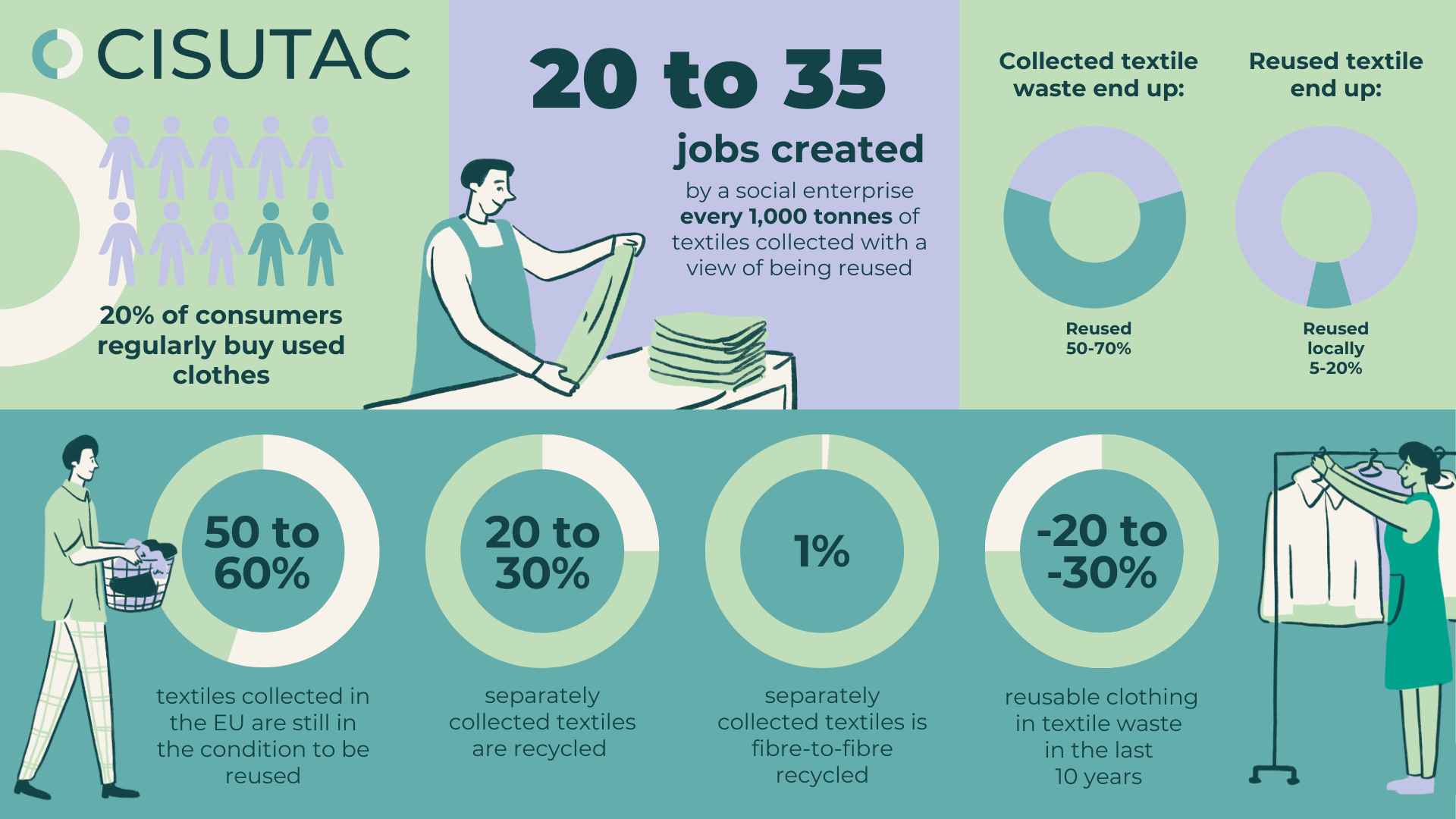
CISUTAC’s comprehensive overview of circular textile business models
The report analyses existing textile repair, reuse and recycling systems in the EU and the trends that influence their operation. Based on these findings, the research explores the reasons behind the difficulties observed and proposes solutions to overcome them. The report’s ultimate objective, aligned with the CISUTAC project’s goal, is to understand how to create an integrated circular textile value chain.

CISUTAC’s unlocking opportunities for circular business models in textiles: phasing out linearity
The aim of this report is to provide a comprehensive overview of circular textile business models. To this end, the report analyses existing textile repair, reuse and recycling systems in the EU and the trends that influence their operation. Based on these findings, the research explores the reasons behind the difficulties observed and proposes solutions to overcome them.

Colour4CRAFTS digital exhibition and virtual tour – “Seasons of Colours” (2024)
Output related to milestone (M14), public exhibitions, for EU funded project, Colour4CRAFTS (no. 101094809). The digital exhibition and virtual tour consist of content and objects displayed at the physical “Seasons of Colours” exhibition held from 10 June to 18 August 2024 at the Arktikum in Rovaniemi, Finland. The exhibition had over 6000 visitors. The digital exhibition and virtual tour can be viewed via the link provided.